The Evolution of a National Ambition: Beyond “30 by 30”
Singapore’s journey toward food security has always been marked by ambition and pragmatism. The original “30 by 30” vision, launched in 2019, aimed to produce 30% of the nation’s nutritional needs locally by 2030 . However, in late 2025, after a year-long review, the government revised this target, acknowledging the significant headwinds facing the local agritech sector, including farm closures and high operational costs .
The new strategy sets more targeted goals for 2035: meeting 20% of Singapore’s fibre needs (vegetables, mushrooms, beansprouts) and 30% of its protein needs (eggs and seafood) through local production . This shift does not represent a retreat but a strategic recalibration. It reflects a deeper understanding of the challenges and a focus on areas where Singapore can realistically achieve the greatest impact, particularly in protein production and high-tech vegetable farming.
Agritech as the Engine of Resilience
The revised targets underscore the indispensable role of agritech. Achieving even these adjusted goals is impossible without the continued adoption of advanced technologies. The government’s renewed commitment is evident in the S$70 million extension of the Agri-Food Cluster Transformation Fund, designed to help farms adopt the very technologies—automation, climate control, and AI—needed to boost productivity and overcome inherent limitations .
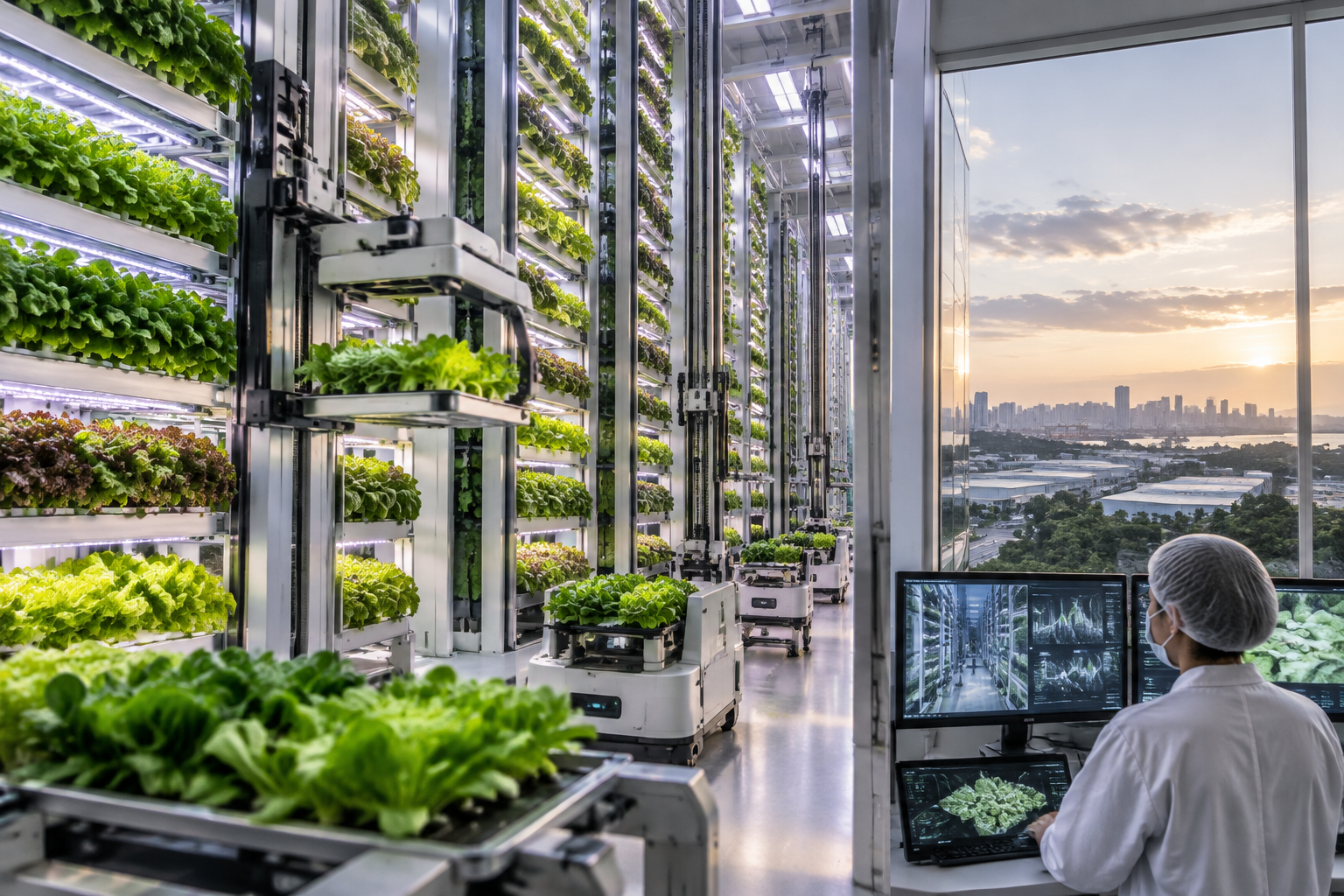
The strategy is multi-pronged. It involves supporting large-scale, high-tech projects like the Greenphyto vertical farm, which pushes the boundaries of what is possible in urban agriculture . It also includes fostering innovation in aquaculture through the new F2TC research center, which aims to reduce feed costs and improve fish health . Furthermore, it encourages the growth of a diverse ecosystem of startups like Polybee and Rize, whose technologies can be applied both locally and internationally .
Building a Diversified and Sustainable Food Future
Singapore’s food security strategy is not just about local production; it is about building a diversified and resilient food ecosystem. This involves a “three food baskets” approach: diversifying import sources, growing locally, and investing in overseas production. Agritech is the common thread that strengthens all three.
The technological capabilities developed in Singapore—from AI-powered vertical farming to smart aquaculture—are exportable assets. By positioning itself as a global hub for agritech innovation, Singapore is not only securing its own food future but also contributing solutions to global food challenges. The journey from the “30 by 30” vision to the 2035 targets illustrates a mature and adaptive strategy, one that uses technology not as a magic bullet, but as a foundational tool for building a sustainable and food-secure nation.