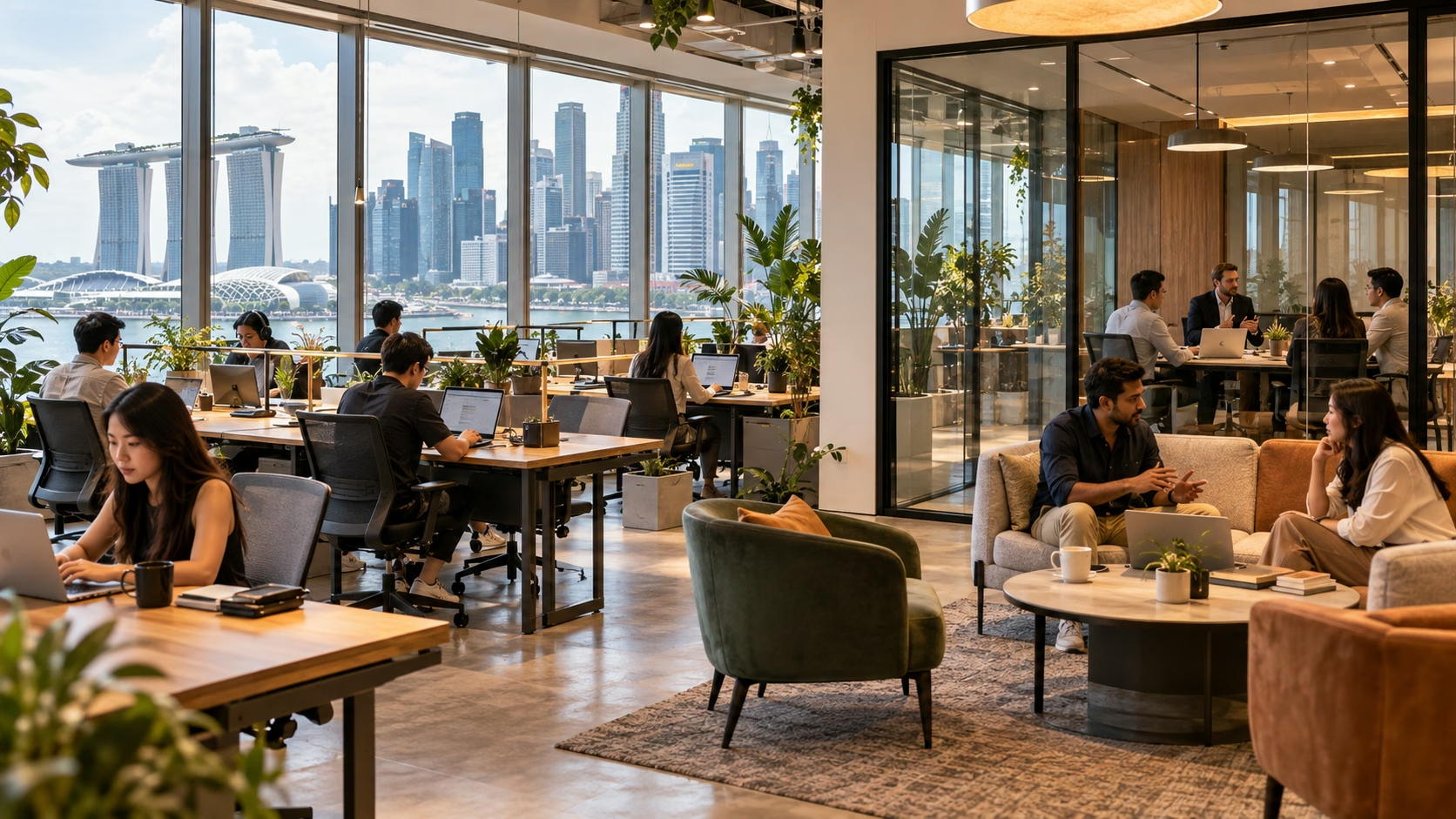
Singapore’s flexible workspace sector has crossed a threshold. As of H1 2026, the market encompasses approximately 4.2 million square feet across 195 centres, with a penetration rate of 5.5 percent of total office stock—the highest in the Asia-Pacific region.
From Niche to Strategic Infrastructure
The CBRE report “The Future of Flex—From Niche to Norm” describes a market that has evolved far beyond its origins as a solution for startups and mobile professionals. Today, premium hospitality-led operators compete alongside value-tier providers in shophouses and suburban business parks. Management agreements and revenue-sharing structures are replacing traditional leases. The top three operators control close to half the market.
For startups, this maturation cuts both ways. Consolidation means fewer independent operators, potentially reducing the quirky, community-driven spaces that early-stage founders often prefer. But it also means professional standards have risen across the board—faster Wi-Fi, better meeting room technology, more reliable community management, and greater financial stability among operators.
The Small-Team Dominance
One of the most significant data points for startups is the structural shift toward smaller occupiers. The share of one-to-two desk requirements grew from 50 percent of total flex demand in 2024 to 57 percent in early 2026. Three-to-nine desk requirements account for approximately 32 percent, meaning that SMEs, startups, and hybrid teams now dominate the market.
This is not a temporary pandemic residue. It reflects a permanent change in how early-stage companies structure their physical footprint. A seed-stage startup with five employees can secure a professional CBD address without signing a three-year lease. A Series A company with twenty employees can distribute across two locations—a CBD presence for client meetings and a suburban hub for engineering—without doubling its real estate costs.
Enterprise Demand and the Startup Spillover Effect
JustCo’s data reveals that large companies account for more than 53 percent of workstation occupancy across its network. Enterprise adoption of flex space has a counterintuitive benefit for startups. When MNCs occupy coworking buildings, they bring corporate development teams, innovation scouts, and procurement officers into the same physical environment as early-stage founders.
Accidental collisions—a startup founder sharing an elevator with a corporate innovation lead, or overhearing a procurement conversation at the coffee bar—are not guaranteed outcomes. But the probability is higher in a mixed-occupancy coworking building than in a startup-only incubator. The enterprise presence subsidises the amenity quality that startups enjoy at lower price points.
What Founders Should Watch in Late 2026 and 2027
Average contract lengths have increased from 10.8 months in 2023 to 12.7 months in 2025, signaling that flex space is being embedded into long-term real estate strategies. For startups, this means operators are becoming more willing to offer customised terms and dedicated suites, not just hot desks.
The risk is pricing. Average desk rates rose 15 percent in Q1 2026 alone. If the CBD Grade A office rent rally continues—gross effective rents rose 1.1 percent in Q2 2026, the sixth straight year of growth—coworking rates will follow. Founders should lock in favourable terms now rather than assume that the current affordability advantage will persist indefinitely.
The 4.2 million square foot market is not just a real estate statistic. It is the physical infrastructure layer of Singapore’s startup economy. And in 2026, that layer is stronger, more professional, and more strategically important than at any point in its history.