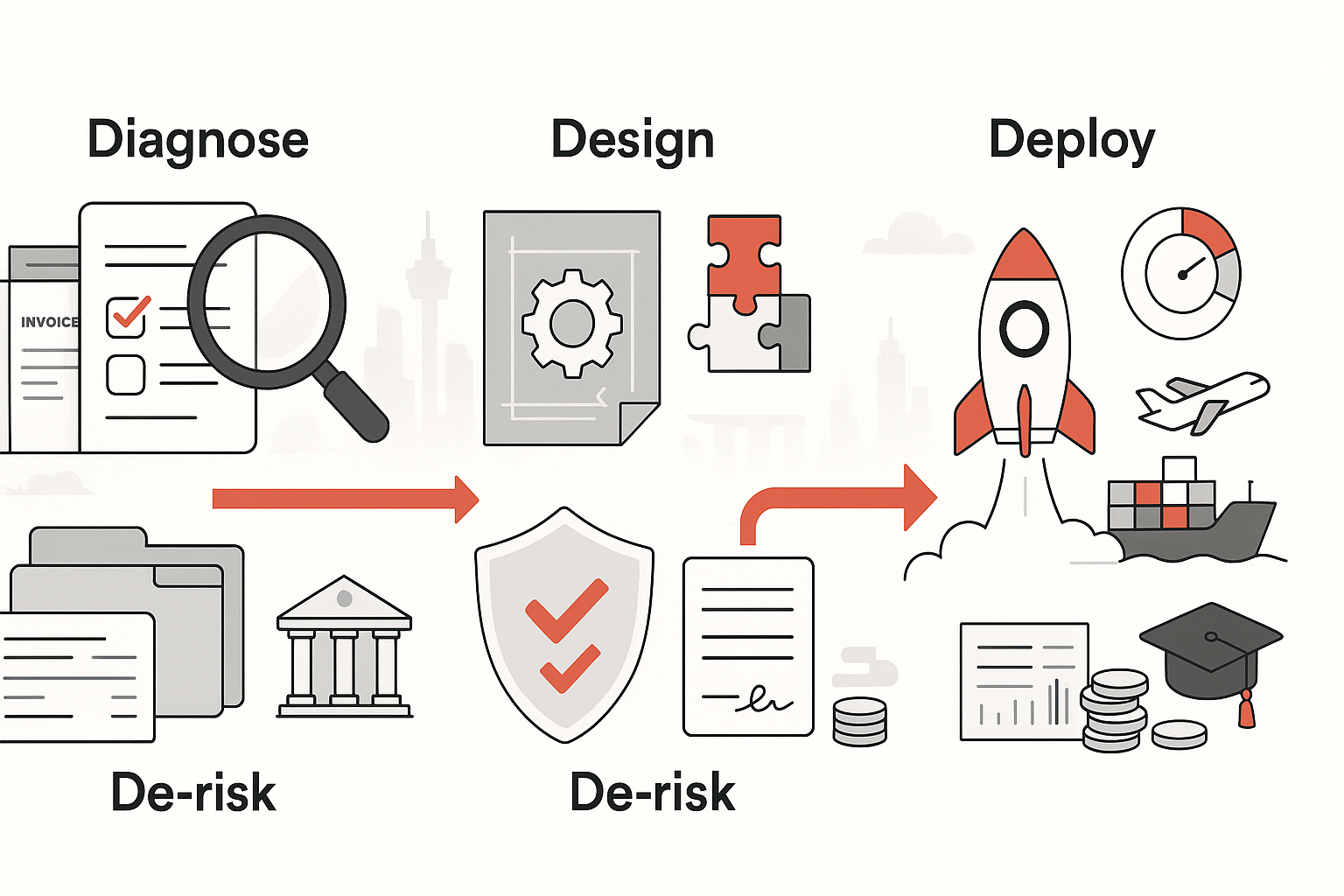
Singapore’s SMEs are not short of financial tools. They are short of a single, coherent view of their cash. Mastercard’s 2026 survey found that 55 per cent of Singapore SMEs use fintech accounts for specific business needs, and among those with multiple accounts, 48 per cent say they do so to manage cash flow. Across APAC, SMEs juggle an average of five business tools and four payment methods for business expenses.
That fragmentation is the quiet cash flow problem of 2026. More accounts and more payment rails can increase optionality, but they also multiply the number of places where liquidity can hide.
The Multi-Account Reality
Separating domestic and international transactions is the second most cited reason for holding multiple accounts, at 42 per cent, followed by faster payments at 41 per cent. This behaviour is rational: different rails solve different problems. But without consolidation, an SME can hold surplus cash in one account while drawing down a credit line in another—a self-inflicted liquidity inefficiency that no government grant can fix.
The integration imperative is already visible in demand. Ninety-four per cent of respondents are interested in adopting at least one additional business tool, and 74 per cent say integrated tools are critical to day-to-day decision-making. The market signal is not “more tools”; it is “fewer seams”.
From Visibility to Decisioning
A consolidated dashboard that shows balances is table stakes. The more valuable layer is decisioning: flagging when a receivables delay will breach a payroll date, or when a supplier’s early-settlement discount is worth more than the cost of short-term credit. Banks and fintechs are moving in this direction. DBS, for example, launched an SME initiative in August 2026 that includes digital payments transformation and the ability to lock in exchange rates in advance without credit lines, protecting cash flow and margins on cross-border transactions.
The SME’s job is to define the decision rules before adopting the tool. What is the minimum cash buffer? Which payments are non-negotiable? At what point does a late customer trigger a credit hold? A tool without rules simply automates the status quo.
The Cybersecurity Blind Spot
Seven in ten SMEs consider protection from cyber threats a high priority, but only 39 per cent currently use cybersecurity tools. That gap is a cash flow risk, not just an IT risk. A payment fraud incident or a ransomware event can freeze operating accounts for days, precisely when liquidity is tightest.
The practical response is to treat cybersecurity as part of the cash flow control framework: multi-factor authentication on every payment rail, separate approval workflows for high-value transfers, and a tested contingency plan for account access disruption. None of these require a large budget; they require the same discipline that SMEs already apply to credit control.
The fintech layer is not a substitute for financial judgment. It is an amplifier of it. The SMEs that benefit most in 2026 will be those that use integrated tools to shorten the distance between seeing a cash flow signal and acting on it.