The Hardware Turn
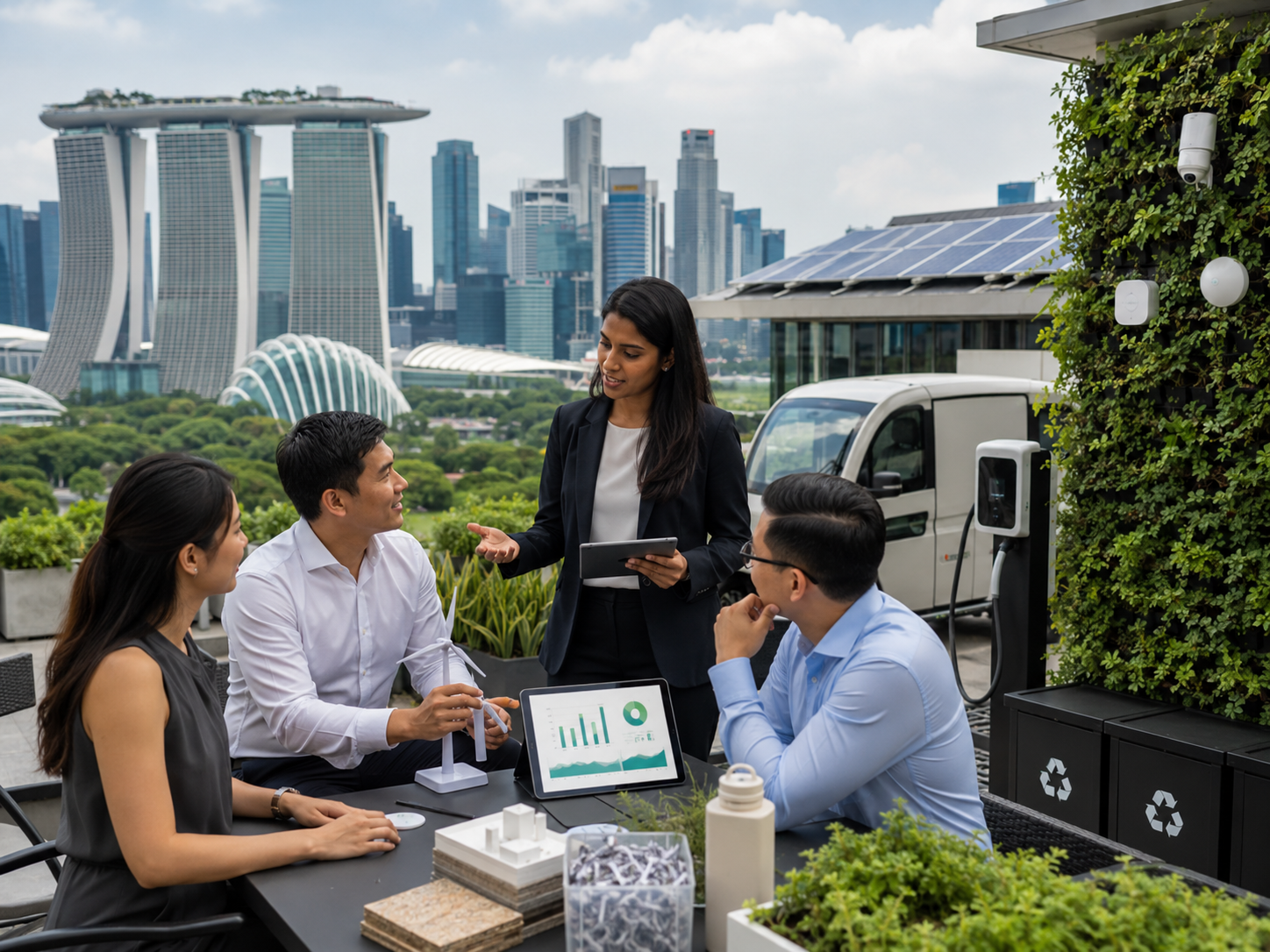
For much of the last decade, climate-tech in Singapore was dominated by software and carbon accounting—important, but insufficient for industrial decarbonisation. The current wave is visibly hardware-heavy. Startups are building transformers, vessels, electrolysers, and capture modules that must operate in real industrial environments, not dashboards.
Amperesand and the Grid Bottleneck
Amperesand, a deep-tech spin-off commercialising medium-voltage solid-state transformers, raised $80 million in Series A and is preparing to deliver 30 megawatts of commercial systems in 2026, with a focus on hyperscale AI data centres. The technology addresses a physical constraint: AI data centres create volatile electrical demand that stresses conventional grid infrastructure. Solid-state transformers can smooth load spikes and improve power quality, making them a grid-resilience product as much as a decarbonisation product.
The startup’s partnership with STT GDC and LITEON on an HVDC testbed in Singapore demonstrates how hardware startups can access real-world validation without owning expensive infrastructure. That testbed model is likely to spread as industrial incumbents look for external innovation to meet efficiency and emissions targets.
Pyxis and Maritime Electrification
Singapore’s maritime sector is another hardware frontier. Pyxis Maritime, founded in 2022, develops electric harbour craft and operates charging stations, and in January 2026 secured investment from MOL PLUS, the venture arm of Mitsui O.S.K. Lines. The strategic logic is straightforward: Singapore is one of the world’s busiest bunkering and port hubs, and harbour craft are a concentrated, high-utilisation emissions source that can be electrified with predictable routes and return-to-base charging.
Pyxis’s funding is notable because it comes from a maritime incumbent, not a generalist climate fund. That signals a shift from venture-led experimentation to industry-led adoption, where the customer is also an investor.
Ammonia Cracking and the Hydrogen Pathway
On the hydrogen side, Amogy is piloting ammonia-cracking technology at Singapore’s Low-Carbon Technology Translational Testbed (LCT³) on Jurong Island, with a module designed to produce up to one tonne of hydrogen per day starting in 2027. The project is supported by A*STAR and is part of a broader effort to test hydrogen carriers under industrial conditions. Meanwhile, startups such as CRecTech are developing catalytic routes to green hydrogen and renewable methanol.
What Distinguishes This Wave
The common thread is physical integration. These startups are not selling offsets or promises; they are selling equipment that must fit into existing industrial systems—grids, vessels, chemical plants, and testbeds. That makes the sales cycle longer and the capital requirement higher, but it also creates defensible positions once a technology is specified into an industrial facility. Singapore’s funding programmes, testbeds, and carbon price are increasingly designed to support exactly this kind of hardware-led decarbonisation.